


Fighting Climate Change through Decarbonization
Climate change is already impacting our world through shifting weather patterns, extreme weather events, rising sea levels, public health threats, changing ecosystems, and threatened wildlife populations – resulting in complex economic and social impacts .
The primary drivers of climate change are the greenhouse gas (GHG) emissions produced by fossil fuel combustion. UC Davis has committed to mitigating climate change by drastically reducing fossil fuel consumption and pursuing comprehensive direct decarbonization strategies throughout campus operations.
Greenhouse Gas Emissions
How we measure
UC Davis takes an annual inventory of all greenhouse gas emissions under its operational control. This report is published in an online greenhouse gas emissions accounting platform, the Climate Registry.
UC Davis’ greenhouse gas inventory is divided into three “scopes,” which indicate the level of control an entity has over why those greenhouse gases were emitted.
Emission Scopes
Scope 1 emissions directly result from a source owned or controlled by an organization; for UC Davis, these emissions are from our campus operations, primarily the heating and cooling of the over 5,000 buildings across our campuses.
Scope 2 emissions are indirect emissions from the generation of purchased energy used by the university; for UC Davis these are purchased utilities, primarily electricity provided by regional energy utility companies.
Scope 3 emissions come from sources not owned or directly controlled by the university but related to campus activities, including things like the emissions associated with the breakdown of campus-produced waste in landfills.
Greenhouse gas emissions are commonly measured in metric tons of carbon dioxide equivalent (MTCO2e). This metric takes into account that different greenhouse gases have different global warming potential.
Emission Reduction Goals
As of July 2023, The University of California has committed to fully decarbonize all campuses and academic health centers by 2045. This goal aligns with California state policy on decarbonatization adopted in AB-1279.
These climate action goals, as incorporated into the University of California Sustainable Practices Policy, direct UC locations to set ambitious greenhouse gas emission reduction targets for 2030, 2035 and 2040.
UC Davis’ goals for greenhouse gas reduction, compared to 2019 levels, are
- 15 percent reduction by 2030
- 55 percent reduction by 2035
- 90 percent reduction by 2040
More Sustainable Practices Policy Goals
- Policy requires that campuses and the UC Office of the President purchase 100% clean electricity as of 2025
- At a minimum, Scope 3 emissions reduction targets will align with the State of California’s goals and policies to achieve climate neutrality by 2045 or sooner.
Taking Action
Fossil Fuel Free Pathway Plan (FFFPP)
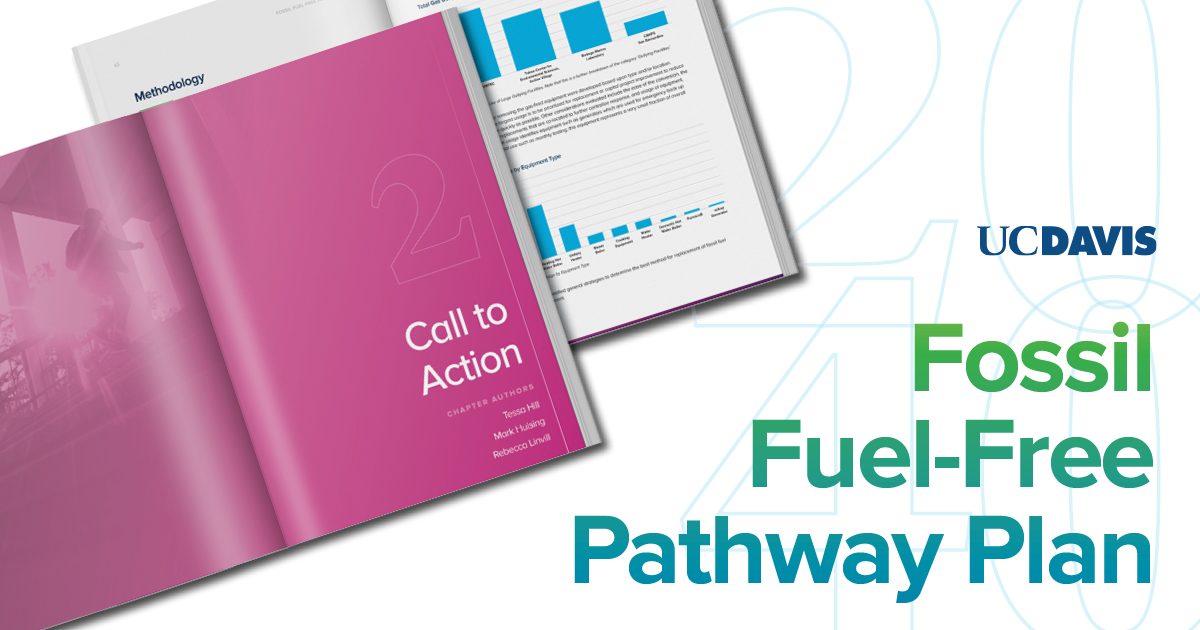
At the end of 2023, UC Davis released a comprehensive Fossil Fuel-Free Pathway Plan, or FFFPP, a roadmap for how the university can eliminate 95% of fossil fuel use from university operations by 2040. The pathway plan includes a comprehensive set of decarbonization strategies for the university’s district heating systems, stand-alone buildings, fleet vehicles, energy infrastructure, space management, and capital planning.
The FFFPP includes the Davis campus, UC Davis Health, Aggie Square, Tahoe Environmental Research Center, Bodega Marine Laboratory, and multiple outlying and leased properties. The document stands as the earliest plan for a multi-campus UC, a UC with a medical center and one of the most extensive plans within the U.S. higher education sector.
More about the FFFPP
Learn more about the development of the FFFPP and download the full plan
Big Shift
The Big Shift is a campus-spanning project updating the university’s heating infrastructure from a steam-based, fossil-fuel reliant system to a hot-water based system that can be fueled by renewable sources that don’t produce greenhouse gas emissions.
The Big Shift is the most impactful decarbonization strategy identified in the FFFPP. The implementation of the Big Shift is projected to reduce fossil fuel usage on the Davis campus by 80 percent, compared to 2019 levels.
Learn more about the Big Shift
Climate Action Fellows
The Bonnie Reiss Leading on Climate Student Fellowship program engages and energizes students in support of UC’s climate action goals. The goals of the fellowship program are to actively engage students in shaping the university’s climate action programs and supporting the university’s aggressive goals for reducing greenhouse gas emissions while creating a more equitable, sustainable, resilient and healthy world.
Learn more about the Climate Action Fellows program
Climate Action Plan
UC Davis is working on a comprehensive Climate Action Plan, or CAP, to serve as a guide for the university’s decarbonization efforts. The CAP will use updated data to identify strategies to meet the university’s goals for reducing greenhouse gas emissions.
FAQ
- What happened to the UC's carbon neutrality initiative?
- The new direct decarbonization goals supersede UC’s carbon neutrality goal, which was established in 2013 as part of the Carbon Neutrality Initiative (CNI). UC would have needed to rely heavily on purchased carbon offsets to achieve its 2025 target. In line with the best current science, the new climate goals prioritize direct reductions in greenhouse gas emissions.
- What role do carbon offsets play in the university’s decarbonization goals?
- University of California goals prioritize investment into direct decarbonization efforts over purchasing carbon offsets to mitigate carbon emissions.