




Climate change is one of the great existential challenges we face in our time.
Background
Fossil fuel combustion is the predominant source of greenhouse gas (GHG) emissions on UC Davis campuses. GHGs emitted when fossil fuels are burned are the primary cause of climate change. The effects of climate change are being felt in shifting weather patterns, extreme weather events, rising sea levels, public health threats, changing ecosystems, and threatened wildlife populations. These effects, in turn, have serious economic and social impacts. UC Davis is currently preparing a plan to move away from fossil fuel use.
UC Carbon Neutrality Initiative
The University of California has committed to drastically reduce its carbon emissions by becoming carbon neutral by 2025. The University of California Carbon Neutrality Initiative, established in November 2013 by The Regents of the UC and UC President Janet Napolitano, commits all UC locations to the goal of emitting net zero greenhouse gases from buildings and vehicle fleets by 2025. The University of California is the first major research university system to set this goal. The Carbon Neutrality Initiative target has been incorporated into the UC Sustainable Practices Policy.
Our Emissions Context
Many factors influence how and why we emit GHGs at UC Davis:
- Growth. To fulfill its mission and serve students, UC Davis continues to grow. To meet our UC climate protection goals, we have to implement strategies for growth and development that do not increase emissions.
- Complex operations and emissions sources. Multiple, interconnected campus systems affect greenhouse gas emissions, including infrastructure, energy, transportation. UC Davis owns and operates a wastewater treatment plant, electrical substation, central heating and cooling plant, water wells and surface water distribution, and public transit system in Davis, and a combined heat and power plant in Sacramento. Our energy contracts include multiple power suppliers.
- Campus size. UC Davis is the largest UC campus with 5,300 acres and more than 1,000 buildings in Davis and Sacramento.
- Campus activities. Faculty, research staff and students conduct a large amount of energy-intensive laboratory research and work with patients in medical and veterinary hospitals and clinics.
- Our geography. We are located in the Sacramento Valley, with cool winters and hot summers. We often focus on our hot summers. But, we have, on average, more heating degree days than cooling degree days, which means we use energy to warm our buildings to comfort temperatures, as well as to cool our buildings.
Our Greenhouse Gas Emissions Inventory
We annually report our GHG emissions in an inventory, which is a measuring of our GHG emissions that is audited by an independent verifier. We file our inventories with The Climate Registry, a non-profit North American organization. We account emissions under our operational control.
GHG emissions are commonly measured in metric tons of carbon dioxide equivalent (MTCO2e). This metric takes into account that different greenhouse gases have different global warming potential.
Understanding the "Scope" of Emissions
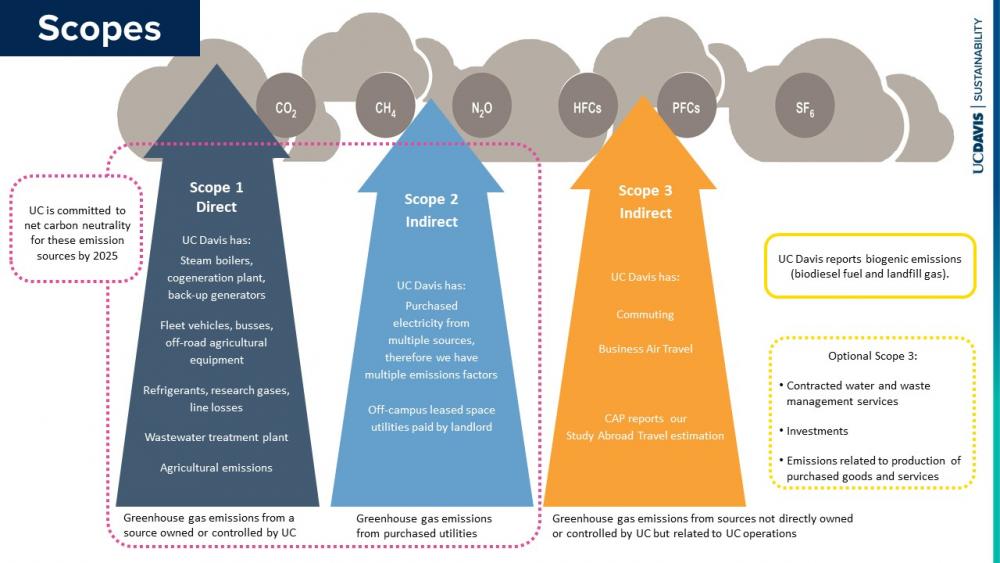
GHG emissions are accounted by their “scopes,” which indicate the level of control an entity has over why those GHGs were emitted. Emissions are classified into three scopes. At UC Davis, our emissions scopes are characterized as:
- Scope 1 are direct emissions from a source owned or controlled by an organization; for UC Davis, these emissions are from our campus operations.
- Scope 2 are indirect emissions from sources that are owned or controlled by an organization; for UC Davis these are purchased utilities, primarily electricity.
- Scope 3 are emissions from sources not owned or directly controlled by the university but related to campus activities.
The graphic below shows our UC Davis emissions sources, by scope.
The UC policy goals for climate protection cover the following scopes of emissions:
- The 2020-2025 goal includes Scope 1 and 2 emissions, and Scope 3 commuting and business travel emissions.
- The 2025 carbon neutrality goal includes our Scope 1 and 2 emissions.
- The 2050 carbon neutrality goal currently includes our Scope 3 commuting and business travel emissions.
Establishing a Baseline
In the UC Davis Climate Action Plan, GHG emissions are calculated back to 1990, using hard data when available and projected data when hard data are not available. Nearly every source of emissions is included. Calculated emissions for 1990 were 142,000 metric tons of carbon dioxide equivalent with a 73 percent increase by 2000 to 246,000 MTCO2e.
Sustainability Goals
Climate Protection
The UC Policy on Sustainable Practices includes three current climate protection goals:
- Reduce greenhouse gas emissions to year 1990 levels by 2020.
- Achieve climate neutrality for Scope 1 and 2 sources by 2025.
- Achieve climate neutrality from specific Scope 3 sources by 2050 or sooner.
A previous climate protection goal to reduce GHG emissions to 2000 levels by 2014 has been removed from the policy, because the goal is in the past, and has been surpassed by the current goal to maintain 1990 levels of emissions. UC Davis exceeded that goal, and met a stretch goal for 2014 that was set in the CAP.
The UC Policy on Sustainable Practices (SPP) calls for other decarbonization and energy efficiency measures related to climate action:
- Energy efficiency (SPP Sections V.A.3., V.A.5., and V.B.1.)
- New construction targets (SPP Sections III.A.1., III.A.2., V.A.1., V.A.2., V.A.3., V.A.5.)
- Energy efficiency targets (SPP Sections III.B.1., V.B.1.)
- Renewable energy targets (SPP Sections III.B.2., III.B.3., III.B.4., V.B.2., V.B.3., V.B.5.)
- Carbon neutrality (SPP Section III.C.1., III.C.2., IIII.C.3, V.C.2, V.C.5.)
- Building decarbonization (SPP III.A.3. and V.A.4.)
- Decarbonization of major fossil fuel-using campus infrastructure (SPP V.C.6.)
- Carbon offsets (SPP Sections III.C.2., V.C.9.)
Progress
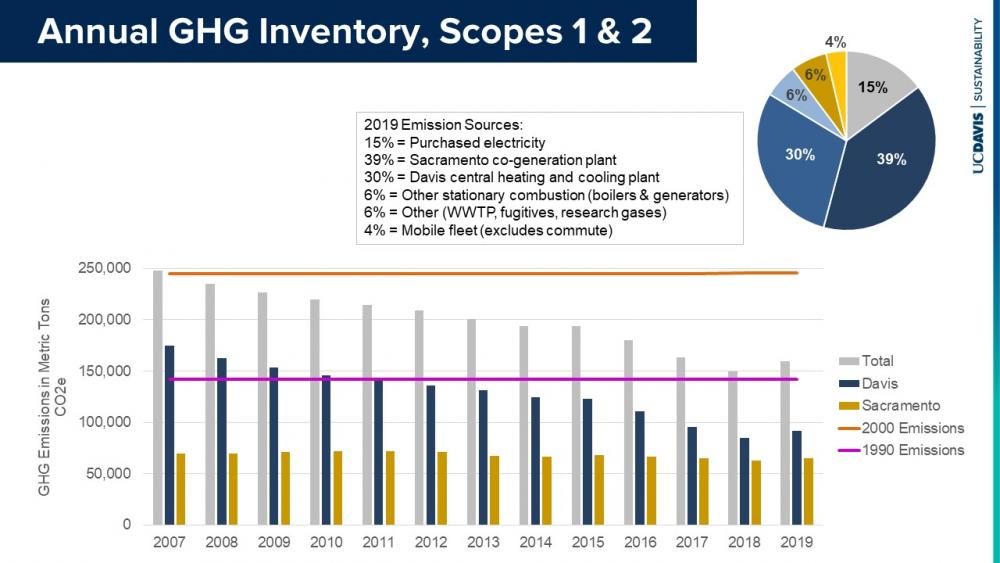
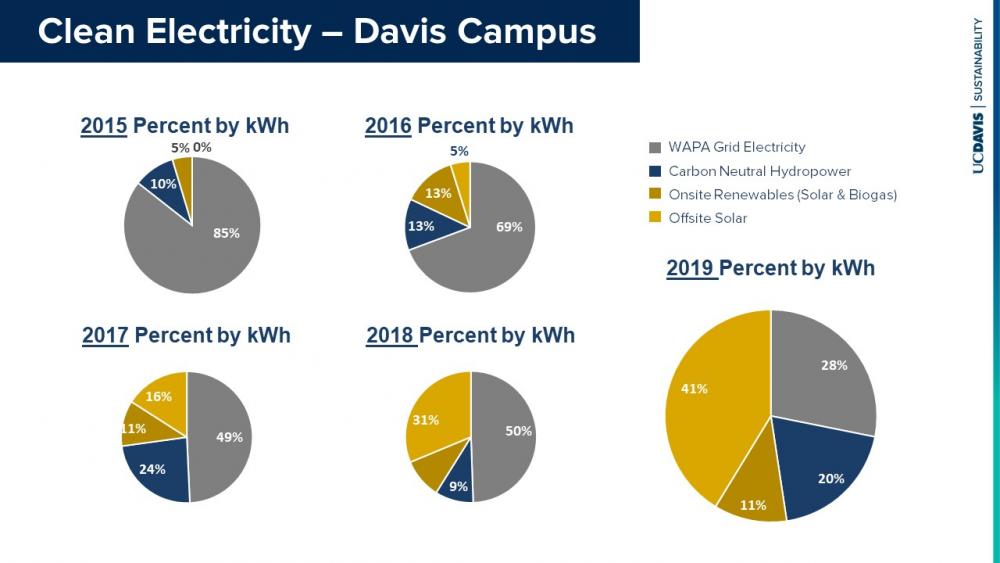
Contribution to total UC Davis 2019 GHG emissions, by location:
- Davis Campus: 57%
- Health System: 41%
- Outlying Facilities: 2%
Contribution to total UC Davis 2019 (pre-pandemic) GHG emissions, by scope:
- Scope 1 and 2 emissions: 62 percent
- Scope 3 commuting and business travel emissions: 38 percent
Both the Davis and the Sacramento campuses are subject to the California Cap and Trade regulatory program because each campus emits more than 25,000 MTCO2e per year at this time.
The Sustainability team is currently assembling and verifying the 2020 and 2021 GHG inventories.
Climate Action Plan
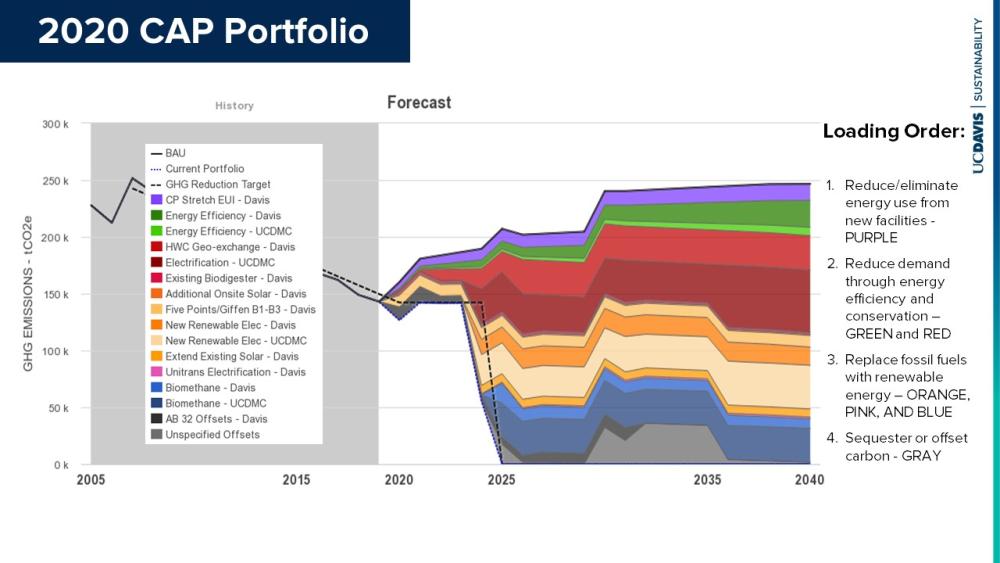
UC Davis climate action planning uses a “loading order” of actions:
1. Reduce/eliminate growth of total campus energy use due to new facilities
2. Reduce demand:
a. Improve energy efficiency at existing facilities
b. Reduce user demand through conservation behaviors
3. Replace fossil fuels (high GHG emissions) with renewable energy
4. Sequester or offset carbon
The UC Davis Climate Action Plan (CAP) is the roadmap for reaching campus climate goals. It is prepared by the Office of Sustainability, which analyses campus issues relating to GHG emissions, energy use and energy sourcing. The plan presents calculations of current and past GHG emissions, establishes emissions reduction goals, characterizes reduction options and provides a blueprint for future action.
The Sustainability team uses a modeling tool to analyze portfolios of solutions to understand, plan and implement various actions to reduce GHG emissions. The model is updated annually to incorporate the latest GHG inventory data and update the solutions. The following “wedge graph” reflects the current plan to achieve carbon neutrality for UC Davis.
The CAP currently places priority on actions that address Scope 1 and 2 emissions related to campus operations, with an eye to the 2025 carbon neutrality goal. An important step forward in significantly reducing our fossil fuel use and GHG emissions is our Big Shift project to move our district steam heating system to more efficient hot water; this major infrastructure investment will also create a path for electrification.
Other CAP strategies to reduce GHG emissions are focused primarily on campus energy use because a large proportion of the energy used to power the campus is generated from the combustion of fossil fuels. Energy efficiency, on-site renewable energy and clean energy programs are discussed in detail in the Energy section of this website. Strategies for new and existing buildings are in the Buildings pages.
As a complement to the Climate Action Plan, UC Davis Health has created a Sustainability Roadmap, which positions the Sacramento campus to shift portions of the campus to all-electric infrastructure over time. This will help the Sacramento campus make progress in achieving the UC’s 2025 carbon neutrality goal.
Scope 3 commuting and business travel emissions are also considered in the CAP. Transportation management solutions are being invested in and implemented at both the Davis and Sacramento campuses to help reduce commuter emissions.
The CAP acknowledges that achieving climate neutrality will require fundamental shifts in policy at the national and international levels, as well as advances in energy production and storage technologies to shift from fossil fuel use.
The CAP includes strategies that make use of RECs and carbon offsets as well.
RECs and Carbon Offsets
Renewable Energy Certificates (RECs) and carbon offsets are market-based instruments for reducing the level of carbon emissions attributed to an organization. These instruments allow organizations to purchase the carbon reduction value of an off-site project, such as a forest, bio-gas production facility or solar array owned by another organization, in order to lower the amount carbon emissions attributed to their own organization. These are legitimate means to reduce overall global emissions, when sourced and retired responsibly. A carbon offset credit is for one ton of GHG emissions. A REC is the equivalent of 1 megawatt-hour of renewably generated electricity.
RECs
UC Davis uses RECs, such as those from the campus's participation in the University's solar power plant in Fresno County, California, to reduce the GHG emissions of our purchased electricity. The Davis campus also contractually holds the RECs generated by our on-site solar power plant, in order to retain the environmental benefits of the renewable energy production.
Carbon Offsets
UC Davis uses some carbon offsets now, and we expect to use more as a transition strategy on our journey to decarbonize our infrastructure and fleets, and address Scope 3 emissions like commuting and business air travel. All campuses in the UC, together with the Lawrence Berkeley National Laboratory and UC’s Office of the President (UCOP) are collaborating on the UC Carbon Offsets Program to ensure we seek out or develop high quality offsets that meet our principles and values.
Below are questions received from campus community members, and answers, with the date each answer was provided. Answers may be updated from time to time, as the offsets program matures and more information is available. Submit your offsets questions to [email protected].
Carbon Offsets FAQ
- Was the carbon offsets section of the UC Policy on Sustainable Practices published?
- May 2022: The carbon offsets sections (III.C.2. and V.C.9.) of the UC Policy on Sustainable Practices were published in March 2022, after a comprehensive, UC-wide review.
- What types of offsets does UC support? And, how are emissions reductions reported?
- May 2022: The UC Carbon Offset Program is investigating two potential sources for carbon offsets that meet our quality standards and principles: offsets available on the voluntary market, and offset projects we develop ourselves, using research from UC faculty, students and staff. The UC is currently researching offset project types and projects available on the voluntary market. For the UC Initiated Offsets, UC will post project design documents, with estimates of the expected lifetime emissions reductions, once UC Office of the President (UCOP) receives them along with the results of peer reviews. As those UC offset projects generate offset credits, the detailed credit issuance reports will appear publicly on the offset registries. UC Davis will also plan to post the issuance reports for the voluntary offsets we buy to achieve carbon neutrality, when we buy offsets. We will make sure that all of the data are included for transparency, to the best of our ability.
- How much CO2 does the UC (and UCD in particular) estimate each of these UC Initiated offset projects has saved over its lifetime?
- May 2022: None of the projects has done much yet because they are still in development. The goal of the pilot award is for each team to develop a proposal for a full-scale offset project that UC campuses can decide to support in exchange for offsets. As of spring 2022, we have proposals from a few of the projects.
- Have the CO2 sequestration estimates of the UC offset program ever been publicly reported? Has UCD ever publicly reported their sequestration estimates?
- May 2022: The projects are not at that stage yet; they are still in development and have not begun delivering emissions reductions. We will also review the methods before considering them as UC-initiated offset projects.
- Where are the other offsets that UC purchases that are not listed on the UCOP webpage linked above? How do these differ among the campuses?
- May 2022: UC Davis does not have records of the other UC campuses’ offsets purchases. UCOP, or the individual campuses, would need to provide that information. We do not know how those campuses’ offsets differ from one another.
- Is there a list of all of the UCD offsets that can be made public?
May 2022: So far, UC Davis has not bought offsets to meet the UC carbon neutrality goals (we have not needed to do so yet). The offsets UC Davis does acquire are through the California Air Resources Board’s Cap-and-Trade program; specifically, UC Davis has swapped Cap-and-Trade California Carbon Allowances that we hold for California Carbon Offsets. The table below shows the offsets we’ve retired through the UCOP-managed central UC program for Cap-and Trade compliance, according to information provided to us from UCOP. The offset project types that have been used are: U.S. Forest Projects, Ozone Depleting Substances Projects, and Livestock Projects.
Note: The offsets quantities listed in the table below include a 24.78% reallocation of emissions from the Davis Medical Center to the UC Davis Campus.California Carbon Offsets, in metric tons CO2 Compliance Year
Davis Campus
Health Campus
Total, UC Davis
2013
5,865
3,781
9,646
2014
5,465
3,712
9,177
2015
5,597
3,803
9,400
2016
5,561
3,799
9,360
2017
5,737
3,835
9,572
2018
5,696
3,723
9,419
2019
5,517
3,657
9,174
2020
5,226
3,597
8,823
- The UC Policy on Sustainable Practices, Section V.A.4., calls for each campus to assess Scope 1 emissions from major fossil fuel-using campus infrastructure by 2035 or when major repairs are needed, and to determine a decarbonization pathway for 80% of the Scope 1 emissions from that campus infrastructure. When does UCD estimate our heat and power plant[s] need major renewal?
- May 2022: The Big Shift project is part of proactive capital renewal for our district heating system and our shift away from fossil-fuel use. We have completed the first major neighborhood of that project, and we are underway with the construction planning for the second large phase of the Big Shift, which will install heat recovery chillers and replace the steam system in a second quadrant section of the Davis campus. In addition, we are underway with a Fossil Fuel-Free Pathway Plan for all of UC Davis that will analyze actions and propose dates for the remainder of our steam system and for the co-generation plant at the Sacramento campus.
- How does UCD's timeline for renewal of our FF infrastructure compare to the 2035 date for UC-wide offset reevaluation? Will the question of tapering off offset reliance before 2035 be considered as a part of the 2022 plan to decarbonize the UC?
- May 2022: The preferred climate action plan scenario that UC Davis has prepared anticipates using offsets as mainly a “bridging” strategy on our journey to decarbonization. With the Fossil Fuel-Free Pathway Plan (FFFPP) process, UC Davis is ahead of the 2035 date to evaluate our major natural gas-fired infrastructure, and we will analyze offset use. The FFFPP is for UC Davis, and will not cover all of the UC. Each UC campus is responsible for preparing its own plans for decarbonization, electrification and/or other climate action.
Other Campus Climate Action
Academic Research and Teaching
The University of California is pursuing carbon neutrality through our research and teaching, as well as our operations. UC faculty, including UC Davis faculty members, created a roadmap and the Bending the Curve executive summary.
UC Davis researchers are leading contributors to the understanding of climate change causes, effects and solutions. Our campuses are frequently used as a proving ground for technologies developed here. Implementing practical solutions is a collaborative effort involving research units and administrative departments.
Founded by the UC Davis John Muir Institute, the One Climate Initiative takes multidisciplinary approach to address three long-term goals: create a climate-resilient society, scale solutions to eliminate greenhouse gasses from human activities, and develop new models for human behavior that support sustainability for future generations.
Sequestering Carbon
Sequestering carbon means recapturing it from the atmosphere. Trees and plants do this very effectively, and sequestration is an excellent way to reduce GHG levels in the atmosphere. The UC Davis Arboretum and Public Garden is preparing a Living Landscape Adaptation Plan to steward our campus landscape through climate change and retain benefits such as shading to reduce urban heat island, and carbon sequestration.
Involving the Campus Community in the Pursuit of Carbon Neutrality
We invite campus participation to support the Carbon Neutrality Initiative through engagement programs, including:
- Bonnie Reiss Carbon Neutrality Student Fellowship Program. This program funds student-generated projects that support systemwide carbon neutrality. The program is named for the late UC Regent Bonnie Reiss who was a passionate advocate for action to address global climate change.
- Meet UC Davis's 2020 CNI Fellows
- Apply for a CNI Fellowship (We’ll make this an active link when applications are open.)
- Roots on Campus is a campus tree-planting event whose objective is to sequester carbon and help shape a more sustainable campus environment. The project was initiated by Carbon Neutrality Initiative Student Fellow, Eileen Hollett, in 2019. The inaugural year was sponsored by UC Davis Sustainability and The Green Initiative Fund.
- Read more at: Cool Campus Challenge Creates Shade