



A large proportion of campus resource consumption and carbon emissions is attributable to buildings.
Building Standards Sustainability Goals Progress Campus Actions
Factors that affect building performance include:
- building type (e.g. laboratory, office, classroom, residence hall, etc.),
- building age,
- building orientation to the sun and window placement,
- building insulation, roof and windows,
- type and age of mechanical, lighting and plumbing systems,
- how many people use the building and what type of equipment they use.
Multiple systems can be optimized to minimize resource use and environmental impact, including building materials, energy efficiency and sources, water efficiency, heating, ventilation, air conditioning, ongoing maintenance, cleaning and occupant behavior. The goal is to plan, build, maintain and renovate campus buildings that provide sustainability solutions instead of problems.
Sustainable Building Standards
Under the UC Sustainable Practices Policy, all new buildings, except for acute care facilities, are designed and built to standards developed by the U.S. Green Building Council Leadership in Energy and Environmental Design program (LEED). The UC Davis Health System also follows standards developed by the American Society of Heating, Refrigerating and Air-Conditioning Engineers (ASHRAE).
- LEED standards promote a whole-building approach to sustainability. They take into account the construction process as well as multiple building systems, including site selection, access to transportation, water efficiency, energy use, building materials, indoor environmental quality, occupant education and innovative design. Projects are registered with LEED in the planning phase, then evaluated for certification at a Certified, Silver, Gold or Platinum level after completion. Building standards vary between UC Davis and UC Davis Health because patient care and medical treatment have special requirements.
- ASHRAE standards promote sustainable heating, ventilation, refrigeration and other building systems also guide overall building design.
Sustainability Goals
New Buildings and Major Renovations*
- Satisfy criteria for LEED-BD+C (Building Design and Construction) Silver rating; and strive for Gold rating.
- Meet prerequisites of the Laboratories for the 21st Century Environmental (Labs21) Performance Criteria.
- Outperform energy requirements of California Building Code by at least 20% or meet UC’s whole-building energy performance targets.
- No on-site fossil fuel combustion for space and water heating, except projects connected to an existing campus central thermal infrastructure.
- Achieve at least two points within the available credits in LEED BD+C Water Efficiency category.
* A major renovation is defined as requiring 100% replacement of mechanical, electrical and plumbing systems and replacement of over 50% of interior walls, doors, flooring and ceiling materials.
Acute Care/Hospital Facilities and Medical Office Buildings
- Outperform ASHRAE 90.1-2010 by at least 30%, or meet UC’s whole-building energy performance targets.
Existing Buildings: Sustainable Building and Laboratory Operations
- Submit one pilot building for LEED-O+M (Building Operations and Maintenance) or higher certification.
- Register a master site to certify campus-wide LEED-O+M credits and prerequisites.
- Implement an ongoing Green Lab Assessment Program (learn more about this at
Building Interiors
- Renovations of $5 million or greater that are not major renovations must meet a minimum LEED-ID+C (Interior Design and Construction) rating. (This does not apply to acute care facilities.)
Progress
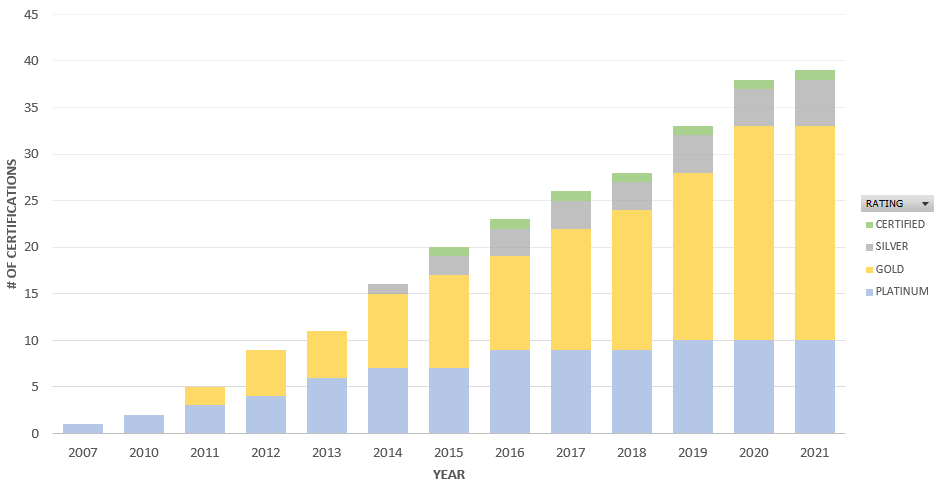
Davis Campus - Cumulative Number of LEED Certifications by Year
As of April 2021
Source: UC Davis Sustainability
* Davis includes the Davis campus, plus outlying facilities associated with research and teaching activities affiliated with the Davis campus
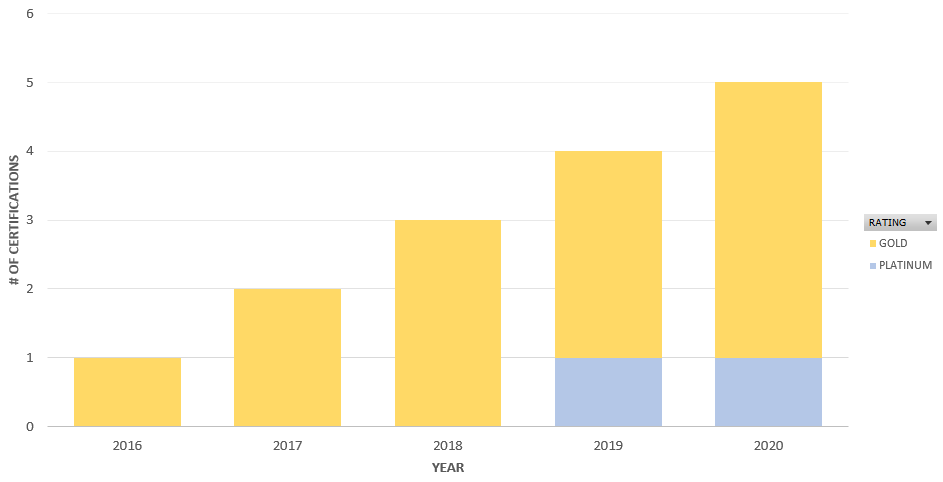
Sacramento Campus - Cumulative Number of LEED Certifications by Year
As of April 2021
Source: UC Davis Sustainability
** Sacramento includes the Sacramento campus, plus clinical and research facilities associated with the Health System.
LEED Certifications
UC Davis is meeting or exceeding systemwide goals for LEED certification. New buildings and major renovations on all UC Davis campuses conform to LEED standards. UC Davis received its first LEED certification in 2007 and has since earned the following LEED certifications:
As of June 2021.
| LEED Certification Level | Davis* | Sacramento** |
| Certified | 1 | 0 |
| Silver | 5 | 0 |
| Gold | 24 | 4 |
| Platinum | 10 | 1 |
| TOTAL | 40 | 5 |
* Davis includes the Davis campus, plus outlying facilities associated with research and teaching activities affiliated with the Davis campus
** Sacramento includes the Sacramento campus, plus clinical and research facilities associated with the Health System.
Campus Actions
- Building Recommissioning – UC Davis has performed “energy makeovers” on several older buildings through the Active Commissioning Enterprise (ACE) program. Retrofitting buildings with smart building controls enables energy use to be closely monitored and fine-tuned. Additional ACE measures include:
- Upgrading lighting to LEDs with occupancy sensors.
- Installing cool roofing and efficient windows.
- Replacing older toilets and faucets with water efficient fixtures.
- Educating building occupants in building controls and behaviors that save water, energy and reduce waste.
- Holiday Shutdowns – Building heating and cooling systems are adjusted or shut down completely during holidays.
- Collaboration – These actions are critical to improving energy efficiency in older structures. Facilities Management, Design and Construction Management, UC Davis research centers such as the Energy and Efficiency Institute, the Office of Sustainability Safety Services, and UC’s energy suppliers have, together, contributed to significant progress improving building performance in existing buildings.